Duellum Veritatis · nightly duel
A nocturnal duel · science explainer
A Conveyor Running Empty
Watch a tracer pour into the tiny channels that hug the brain's blood vessels, and you might think you are watching the brain clean itself. But what enters a pipe is not the same as what leaves the tissue — and when the true bottleneck sits downstream, the pipe can run full while the brain barely clears at all.
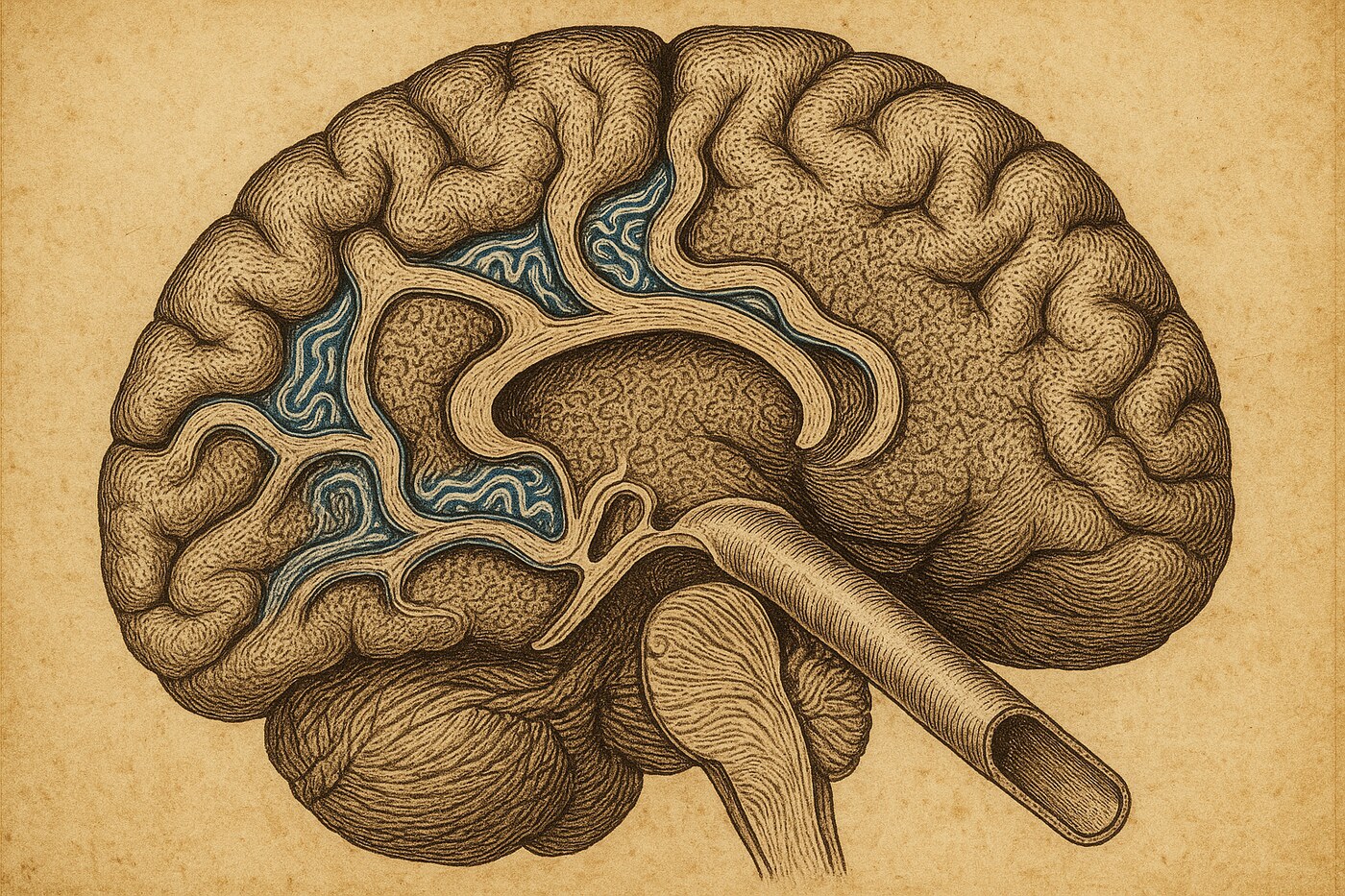
The brain has no lymph vessels of the usual kind. Instead, fluid is thought to wash metabolic waste out along the thin sleeves that wrap every blood vessel — the perivascular spaces. Inject a traceable marker, watch it flow into those sleeves on a scanner, and a natural temptation follows: read how fast the tracer pours in as a measure of how well the brain is clearing itself. This duel asks whether that shortcut is trustworthy — whether the inflow you can image really stands in for the net clearance you actually care about.
Two quantities that look like twins. PVS influx is how much tracer enters the perivascular space — the variable a scanner can watch. Net parenchymal clearance is how much solute actually leaves the brain tissue. Between the entrance and the true exit sits a chain: exchange between the perivascular sleeve and the surrounding tissue, then uptake into the vasculature or drainage onward. The duel turns on whether that chain can quietly snap the link between what goes in and what gets cleared. The physics in one breath. Think of imaged influx as a delivery conveyor running at rate Q. The tissue only truly clears as fast as the slowest step downstream — a series of two resistances, exchange (E) and egress (K), combining into one effective conductance g = E·K / (E+K). When the conveyor is the slow step the two track each other. But when exchange or egress is the slow step — g ≪ Q — the conveyor keeps spinning while almost nothing leaves the tissue. Influx stays high; clearance falls; the proxy lies.The frozen claim
The thesis Aramis was assigned to defend, fixed before the duel and not edited afterwards:
"Tracer influx into perivascular spaces is a valid quantitative proxy for net parenchymal solute clearance."
The falsifier both sides accepted: if a physiologically plausible bottleneck model — with the neutral transport substrate preserved — drives the correlation between influx and net clearance to 0.3 or below, or reverses the ranks, the thesis fails. The agreed pass mark for the thesis was a strong correlation (Spearman ρ ≥ 0.8) holding across the whole plausible parameter box, with no named bottleneck breaking the rank order.


The duel: arithmetic, not rhetoric
Each move was a small simulated world with a known answer, so the sides could see who was right rather than argue it. The neutral transport substrate — the in-channel balance of flow and diffusion (the Péclet number) — was held fixed throughout, so no one could win by quietly changing the substrate. Several things got settled along the way.
Cleared away: a broken first model, honestly retired
The thesis side opened with a numerical model that returned a negative correlation — an obvious artifact. It came from drawing the channel's parameters independently for every point, severing the physical link the model was supposed to carry. Rather than bank a false win, that side named the error and rewrote the model with correct steady-state physics. A clean start, conceded openly by both.
The decisive decomposition
The refuting side then made the move that organised the whole duel. Imaged influx is the conveyor's delivery, Q·C₀. Net clearance is what the tissue actually sheds, g·Cₚ, where the effective conductance g = E·K/(E+K) chains exchange and egress in series. Because Q and g are independent, the link between influx and clearance is not guaranteed — it depends entirely on which step is slowest. The agreed comparator ladder then asked: across named bottleneck regimes, does the correlation hold or break?
Settled: the break tracks how hard the drain is throttled
The thesis side fairly objected that widening the exchange prior symmetrically by several orders is a prior trick, not physiology — and the refuting side conceded that move. The honest test is a single named mechanism from the ladder pushed down by a documented amount, with everything else held in the realistic range. Depress the vascular-egress step alone and watch the correlation fall as the depression deepens.
The matching test for interstitial exchange gave the same answer (ρ ≈ 0.04), and a rank-reversal check found no surviving rank order in either bottleneck. So both halves of the falsifier were met by a named, single-mechanism bottleneck — not by a prior trick. And even before any bottleneck, the full realistic box held only ρ ≈ 0.51, already under the thesis's own pass mark of 0.80.
The verdict
Outcome (who argued better): CON — the refuting side prevailed on argumentation.
Substantive verdict (was the claim true): con — the thesis is rejected on its own criterion.
Here the two axes agree. The refuting side both argued better and was judged closer to the truth: the imaged carrier is not a regime-free proxy for net clearance. The agreement does not upgrade the result beyond a scouting test on a synthetic model.
The arbiter judged that the refuting side held the registered criterion precisely: it separated a broken numerical setup from the real argument, exposed the gap between the thesis side's claimed numbers and the simulation output, and narrowed the model down to a relevant targeted bottleneck instead of leaning on rhetoric. The thesis side conceded each factual point in turn, including that its own realistic-prior run never reached the 0.80 pass mark. The decisive blow was conceptual: conservation of mass binds influx to clearance only if no tracer escapes along the perivascular space — and perivenous efflux breaks exactly that assumption.
Basis: real_compute (attached bundle) · Protocol: PASS (12 moves, clean arbiter verdict) · Order-swap audit: PASS (substantive call "con" on both the natural and the swapped run) · Verbosity note: a confound flag is raised because the thesis side wrote about twice as many words — but the winning side was the shorter one, so length did not buy the result. · Arbiter confidence: not assigned.
What this supports
- A physiologically plausible downstream bottleneck — vascular egress or interstitial exchange depressed by half to one order — is sufficient to drop the influx–clearance correlation to ρ ≈ 0.04, below the rejection line, with the neutral substrate preserved.
- Even with no bottleneck, the full realistic box holds only ρ ≈ 0.51 — short of the thesis's own pass mark of 0.80.
- Where the imaged conduit itself is the slow step (g ≫ Q), the proxy does hold (ρ ≈ 1.00): the coupling is regime-dependent, not universal.
- Conservation of mass ties influx to clearance only when perivascular efflux is absent; perivenous escape decouples them.
What this does not support
- It does not show that real in vivo glymphatic transport lives in a bottleneck regime. The model is synthetic; it proves possibility, not actuality.
- It does not establish universal decoupling — in the conduit-limited regime influx remains a near-perfect proxy.
- It does not pin the real physiological ranges or covariances of flow, exchange and egress in vivo, which could restore or strengthen the link.
- It does not overturn the glymphatic hypothesis — only the use of one imaged carrier variable to stand for net clearance without knowing the regime.
Where the losing side still has a point
The thesis side's strongest objections were fair and shaped the result. It correctly flagged that blurring the correlation with four symmetric orders of exchange variation is a statement about the prior, not the mechanism — and that move was withdrawn. It rightly insisted that the real physiological ranges and covariances of flow, exchange and egress in vivo are unknown, so a single covarying parameter (flow and exchange rising together with pressure, say) could restore the coupling the synthetic model breaks. And the whole result is steady-state: transient accumulation and lag could shift the picture either way. The decoupling shown here is real and named — but it is a statement about what is possible under plausible physics, not a measurement of the living brain.
Prior-work note
This release makes no originality claim. The duel argues a frozen claim drawn from a standing queue, not a specific publication; its contribution is a stress-test of one transport-physics objection to a common imaging shortcut, not a new empirical finding. Novelty status: not an originality claim. The decisive real-data discriminator — whether influx and net clearance actually decouple in vivo under a documented egress bottleneck — is not settled here and remains owed.
Appendix · reproducibility
Numbers and figures come from the attached repro bundle. Script, data, hashes, environment and rerun instructions are recorded in 2026-06-13_compute_manifest.json.
Model: steady-state, well-mixed two-compartment series-conductance transport. Imaged influx = Q·C₀ (perivascular delivery); effective conductance g = E·K/(E+K) chains exchange (E) and egress (K); parenchymal concentration Cₚ = Q·C₀/(Q+g); net clearance = g·Cₚ. Flow Q, exchange E and egress K are independent log-uniform draws; the in-channel Péclet number is held in [0.1, 10] for every point (neutral substrate preserved).
Estimator: Spearman rank correlation between influx and clearance, N = 30 000 samples per regime; deterministic at seed 11.
Environment: Python 3.12.3 · numpy 2.4.4 · scipy 1.17.1 · linux-x86_64.
Headline values: PVS-conduit-limited (g≫Q) ρ = 1.00 · full realistic box ρ = 0.51 · vascular-egress bottleneck ρ = 0.04 · interstitial-exchange bottleneck ρ = 0.04 · egress depth scan (0, −0.5, −1.0, −1.5, −2.0 decades) ρ = 0.51 / 0.31 / 0.17 / 0.08 / 0.02. Thesis pass mark ρ ≥ 0.80; rejection line ρ ≤ 0.30.
script_sha256: sha256:aab7aabe33734c511ffcba52510ff3366de80610cfe40598512eb35cf731acab
2026-06-13_cc_data.json sha256: sha256:5f8c165f3e3e7ab51797083cb7d91e127baf2aae51b227fe46f118c6e8aac94d
Rerun: python3 2026-06-13_repro.py → writes 2026-06-13_cc_data.json
Errata / quarantine: none.
Duellum Veritatis · a public adversarial AI stress-test of a frozen scientific claim · published by Occam Research · engine and arbiter identities withheld by design.